
A Solo AI Workflow Does Not Need Your Entire Archive
Too little context makes an AI workflow ask the same questions; too much hides what matters. Build a minimal context packet from the goal, sources of truth, current state, and acceptance conditions.

A solo operator can waste time in two opposite ways. Give an AI workflow too little context and it asks for the same background every run. Give it everything—old chats, outdated documents, and half-formed ideas—and the few facts that matter now disappear inside the pile.
Treat context as a limited budget. The goal is not to transfer everything you know. It is to help the workflow find the right source of truth, understand the current state, and know when it must stop and ask you.
More context does not mean more understanding
OpenAI's account of building a Codex harness describes how a giant instruction file crowded out the task, code, and relevant documentation. The team replaced it with a short map pointing to structured, verifiable sources of truth. Anthropic's work on long-running agents reached a related conclusion: compaction alone was not enough for reliable handoffs across context windows; later sessions also needed visible progress artifacts and an explicit current state.
These are first-party software-engineering practices, not proof that every publishing, sales, or follow-up workflow needs the same file structure. The transferable principle is narrower: context earns its place when it leads the workflow to the right facts, present state, and next action.
A community project for versioning prompt, memory, scratch, and rule files began from the same practical irritation: those materials mattered, but became messy when they accumulated together. That is a signal, not a universal finding. It still exposes a real maintenance cost for a one-person business: every extra item can become stale, conflict with another source, or be reused in the wrong task.
A minimal context packet has four parts
- The outcome for this run: name a result you can inspect. “Prepare three channel drafts from this week's product progress and return them for approval” is clearer than “handle this content.”
- Where truth lives: provide locations and priority instead of pasting every document. Identify the product record, the source of customer language, and which one wins when sources disagree.
- The current state: preserve completed work, remaining work, and known gaps. A new session should read state instead of reconstructing it from chat history.
- Acceptance and handback: define the output shape, facts that must survive, actions that are forbidden, and the point that requires your approval.
OpenAI's agent guide recommends turning existing procedures into instructions, breaking dense material into clearer steps, and mapping each step to a concrete action or output. For a solo workflow, the useful artifact is not another universal mega-prompt. It is one task card that keeps these four fields current.
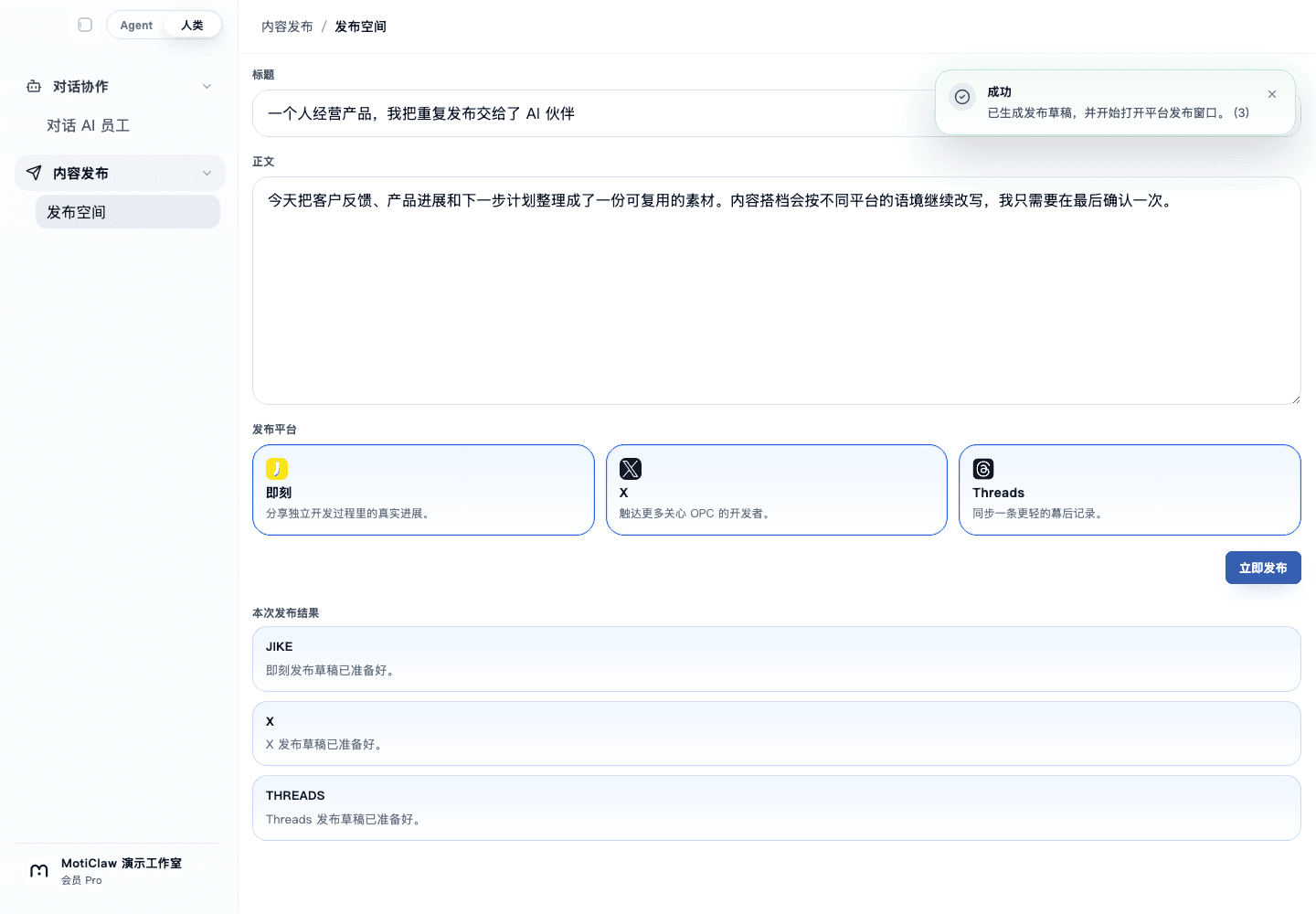
Organize once, then retrieve for each task
In this MotiClaw sample workspace, a solo product operator first turns customer feedback, product progress, and next-week plans into one core packet. Jike, X, and Threads then receive separate drafts. The operator does not repeat the full background three times, and publication still waits for one human confirmation.
That is closer to maintainable context: stable facts are prepared once, channel voice changes by task, and publication authority stays with the person. MotiClaw provides the organize-draft-review path shown in this case. The external projects above are design references; their native capabilities do not prove that MotiClaw provides the same underlying systems.
Know when to add and when to delete
- Add a fact to the source of truth or current state when the workflow repeatedly asks for it and future runs will genuinely reuse it.
- Delete one-off discussion history after its final decision and rationale have moved into the durable record.
- When two sources conflict, do not add a third summary. Mark the owner, freshness, and priority first.
- At the end of a run, preserve only reusable facts, rules, and acceptance checks. Keep temporary reasoning in the run record.
Start with the next task you repeat every week. Create one card with the outcome, sources of truth, current state, and acceptance conditions, then run it three times. When the workflow asks a question, decide whether it uncovered a durable gap or a one-run exception; only durable gaps enter the packet. Work data stays on your device by default; only channels you connect and model calls go online as the task requires. Context begins saving explanation time when you can keep deleting and correcting it.
Get your first AI partner working in 3 minutes
Download MotiClaw for free. Work data stays local by default; only the channels and model calls you connect use the network when a task needs them.
Download free