
01
Fewer tools to juggle
Keep agents, configuration, operations, and delivery closer together.
Solution
Many indie developers are slowed down less by engineering ability and more by a scattered stack: one tool for agents, one for configuration, one for operations, one for delivery. MotiClaw is designed to feel more like a long-term workbench than another isolated interface.
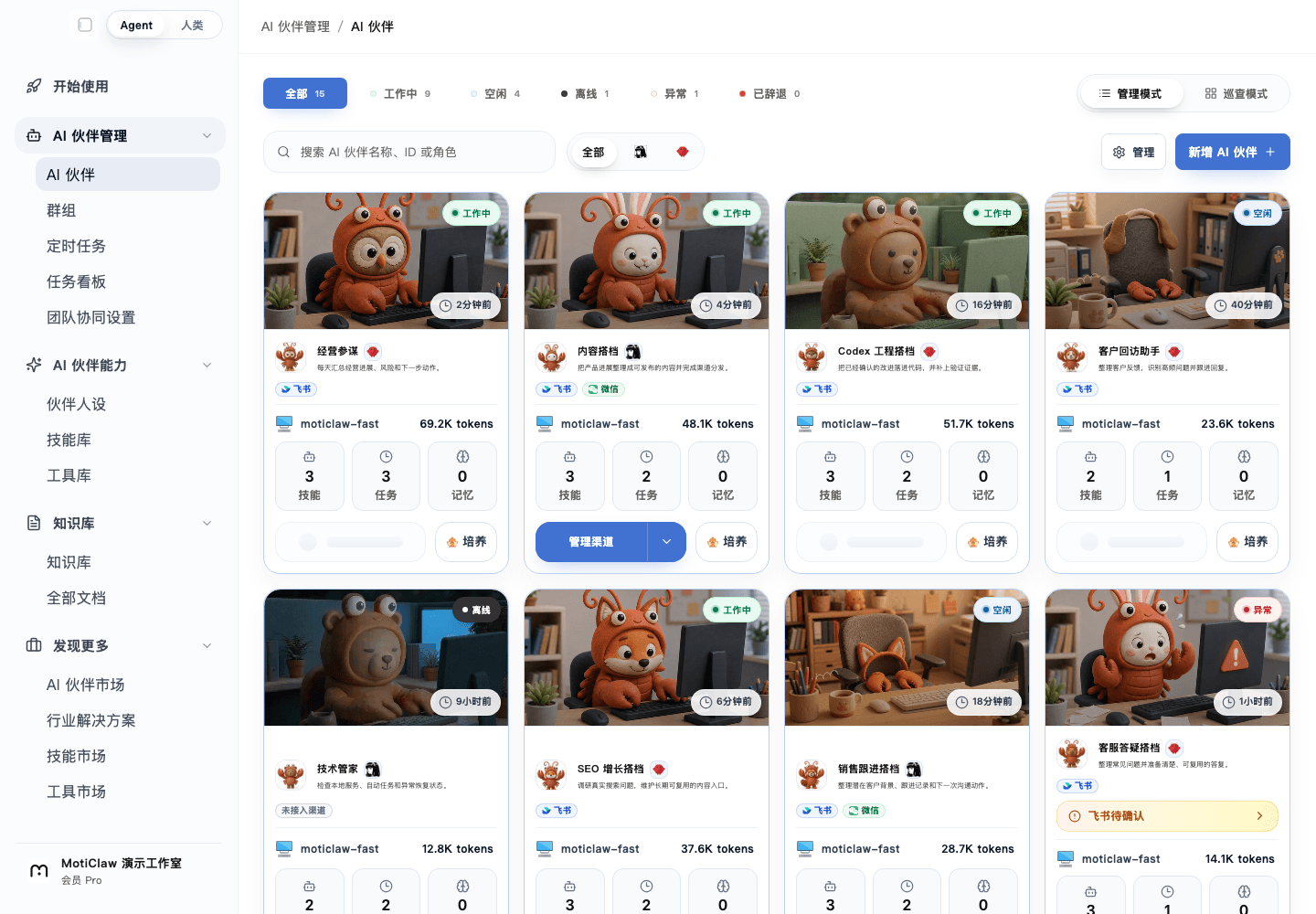
See how the real workbench carries status, tasks, and human review before deciding whether the approach fits.
Open interactive preview01
Keep agents, configuration, operations, and delivery closer together.
02
The goal is not one launch, but something you can keep using and refining.
03
Make your own workflow stable first, then move it into delivery scenarios more easily.
Start here
Put inputs, execution, and human review into one clear path before expanding it.
Start by seeing where services, setup, and operations keep slowing you down.
Reduce how much install, update, repair, and connection management depend on memory and manual switching.
Once your own workflow is stable, it is much easier to package it for clients or long-term service.
If you are the developer, operator, and delivery person at the same time, the drag often comes from state scattered across tools and environments.
What breaks rhythm is rarely only the code. It is repeated switching between service configuration, agent state, installation steps, test outcomes, and delivery artifacts.
Local-first is not just a principle. It changes controllability during debugging, clarifies data boundaries, and makes demos or delivery easier to explain.
When more of the system can be stabilized inside a local workbench first, you can decide later where additional external dependencies actually help.
This becomes more useful if you build agent products, AI tools, delivery packages, or client-specific deployments that need to stay maintainable over time.
AI indie developers usually search for agent management, local AI workbenches, or more stable AI delivery workflows before they search a brand name.
Pages like this answer that intent more directly and then pass users into download, deployment, and capability pages.
FAQ
Both. Many indie developers do product building, demos, deployment, and maintenance at the same time, so a steadier platform layer helps in both directions.
No. You can start with the service and workflow pieces you use most, then expand only when it helps.
Because it usually gives indie developers clearer runtime boundaries, a steadier debugging experience, and a delivery path that is easier to explain.
Next
For AI indie developers, MotiClaw helps turn agent management, service configuration, client demos, and delivery maintenance into a sustainable local-first workflow.
A practical AI agent workflow checklist for indie developers covering inputs, completion criteria, human review, failure recovery, and iteration before scaling automation.
Five common AI agent management workbench mistakes for indie developers: unclear ownership, happy-path demos, missing human gates, invisible states, and scaling too early.
Compare local-first AI agent platforms and cloud SaaS across data boundaries, maintenance, continuity, collaboration, cost, and exit paths before moving a real workflow.
See how MotiClaw brings agent onboarding, status, daily operations, configuration, and delivery into one local-first workbench for FDEs, AI indie developers, and founders.
Run the first step