
01
Stabilize your own flow first
Keep common agents, service configuration, demo material, and maintenance work on one path.
Workflow
When indie developers build AI products or client delivery packages, the hard part is often not creating one agent. The harder part is keeping demos, configuration, fixes, and delivery state from scattering across tools. MotiClaw gives you a local-first workbench to stabilize your own workflow before bringing it into client or partner scenarios.
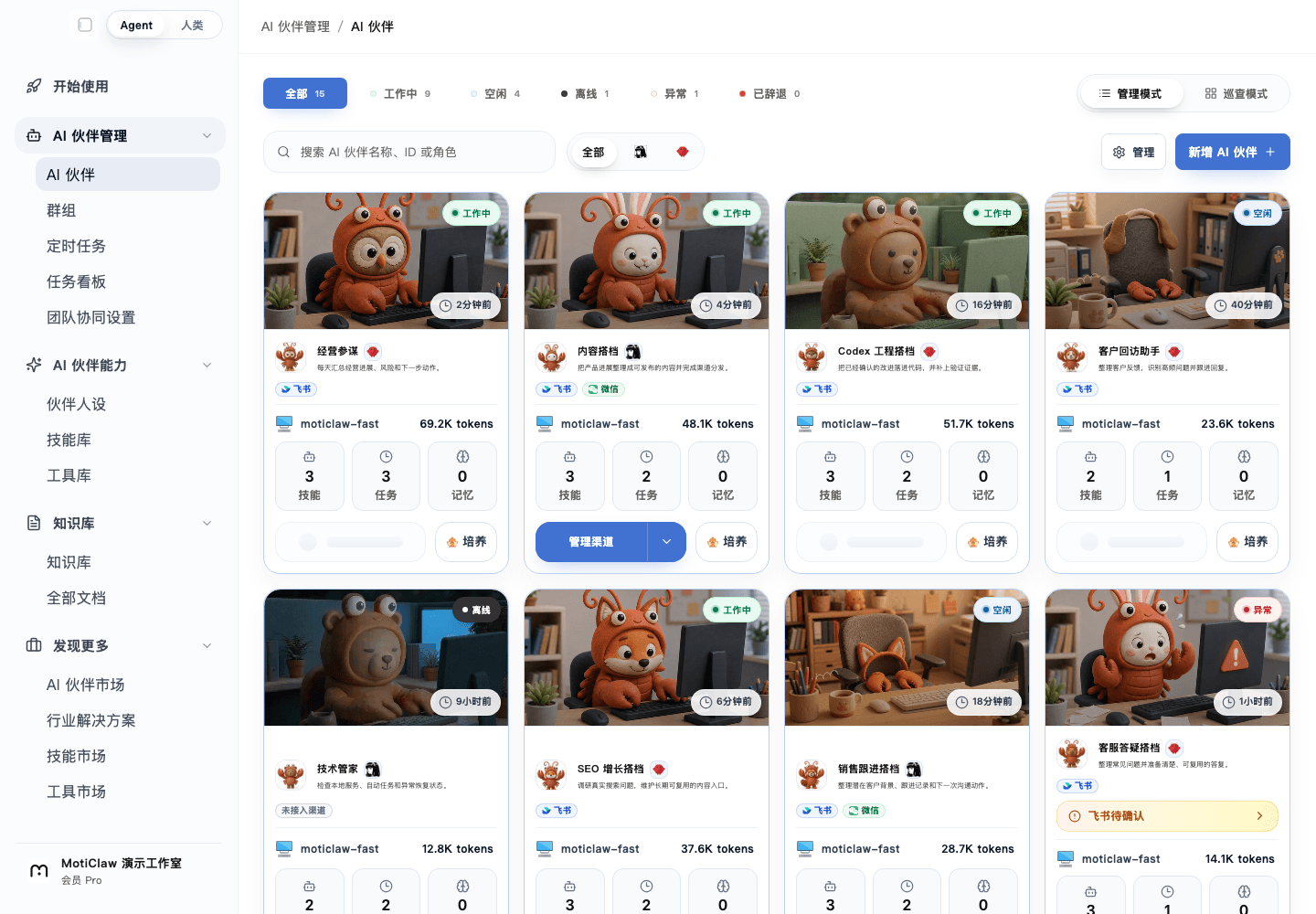
See how the real workbench carries status, tasks, and human review before deciding whether the approach fits.
Open interactive preview01
Keep common agents, service configuration, demo material, and maintenance work on one path.
02
Turn setup, connection, checking, and repair into steps you can reuse next time.
03
Use a proven workbench to support demos, trials, deployment, and ongoing service.
Start here
Put inputs, execution, and human review into one clear path before expanding it.
Start from the agents, models, tools, environment variables, and client settings you touch often, not from an abstract platform plan.
Keep the status checks, data boundaries, download path, and common questions you need before every demo in one place.
After every fix, update, or customer question, keep the reusable steps so the next delivery does not start from zero.
Getting one agent to run is only the beginning. Delivery rhythm depends on whether you can manage the services, configuration, data boundaries, demo state, and maintenance around it.
When that context lives in terminals, docs, chats, and temporary scripts, every customer demo or feedback loop forces you to rebuild the working state again.
AI indie developers often play product, engineering, pre-sales, delivery, and support roles at the same time. Another tool only helps if it makes repeated work more stable.
MotiClaw is not a claim that every scenario can be fully automated. It is a place to bring agent management, configuration checks, client demos, and maintenance feedback into a clearer operating surface.
This should not be only a feature list. It should answer everyday developer questions: which agent needs attention, which configuration requires human confirmation, and which steps an assistant can keep organizing.
Once those questions have stable answers, it becomes easier to turn your own workflow into demos, delivery packages, or long-term services instead of relying on memory each time.
People searching for AI agent management workbenches, agent management tools, or AI indie developer platforms are usually looking for a more stable way to develop and deliver.
By explaining the scenario, starting steps, checks, and next actions, this page can answer a more specific intent than a general brand page and support future community or directory links.
FAQ
Start with the agents you use every day and the ones that affect demos or client delivery most. Capture their state, configuration, inputs, outputs, and maintenance steps first.
No. It fits between development and delivery by collecting repeated checks, configuration notes, demo preparation, and maintenance records.
When your own agent workflow is stable and you can explain data boundaries, runtime behavior, and maintenance ownership, it is a better time to demo or deliver it.
Next
MotiClaw fits AI indie developers who want one local-first workbench for agent management, service configuration, local deployment, and client delivery.
A practical AI agent workflow checklist for indie developers covering inputs, completion criteria, human review, failure recovery, and iteration before scaling automation.
For AI indie developers, this guide compares what must be stabilized between agent demos, client trials, configuration handoff, and long-term maintenance.
Compare local-first AI agent platforms and cloud SaaS across data boundaries, maintenance, continuity, collaboration, cost, and exit paths before moving a real workflow.
See how MotiClaw brings agent onboarding, status, daily operations, configuration, and delivery into one local-first workbench for FDEs, AI indie developers, and founders.
Run the first step