
Your First AI Workflow Should Not Start Fully Automated
Where should a solo operator start with AI automation? Not by outsourcing the decision, but by making the material behind that decision reliably reviewable.

The easiest trap when you start using AI alone is treating “fully automated” as the first milestone: research, decide, publish, and follow up without a pause. The chain looks complete. When the outcome drifts, you cannot tell which step introduced the error.
A steadier starting point for solo operators and indie founders is simpler: do not ask AI to make the decision first; ask it to prepare what the decision needs.
Why unattended should not be the first goal
Anthropic separates predefined workflows from agents that dynamically direct their own process, and recommends starting with the simplest composable solution. Add complexity only when it demonstrably improves the result. OpenAI's agent guide likewise treats guardrails, stopping conditions, and handoff to a person as foundation work, not cleanup after launch.
This does not mean AI cannot complete long tasks. METR's time-horizon work measures how models handle increasingly difficult software tasks at a stated reliability level. It is not a promise that every task below a certain duration will succeed. Capability is growing; a real workflow still needs acceptance points.
One builder report points in the same direction. Even with a multi-agent development pipeline, the solo founder kept human review as a separate phase—not because people should repeat the work, but because someone must own the important decisions.

Choose a first task that meets all four conditions
- It repeats: it appears at least a few times a week, so a win today still matters next week.
- Inputs are findable: raw material has a stable source instead of requiring a fresh context dump every time.
- Output is reviewable: you can compare good and bad quickly rather than trusting a feeling.
- Failure is reversible: the workflow produces a draft, checklist, or options before it pays, deletes, broadcasts, or ships anything.
“Collect this week's feedback, group it into three themes, and list the questions I need to answer” is a better first workflow than “decide what the next release should contain and publish it.” The first prepares your judgment. The second gives away both judgment and consequence.
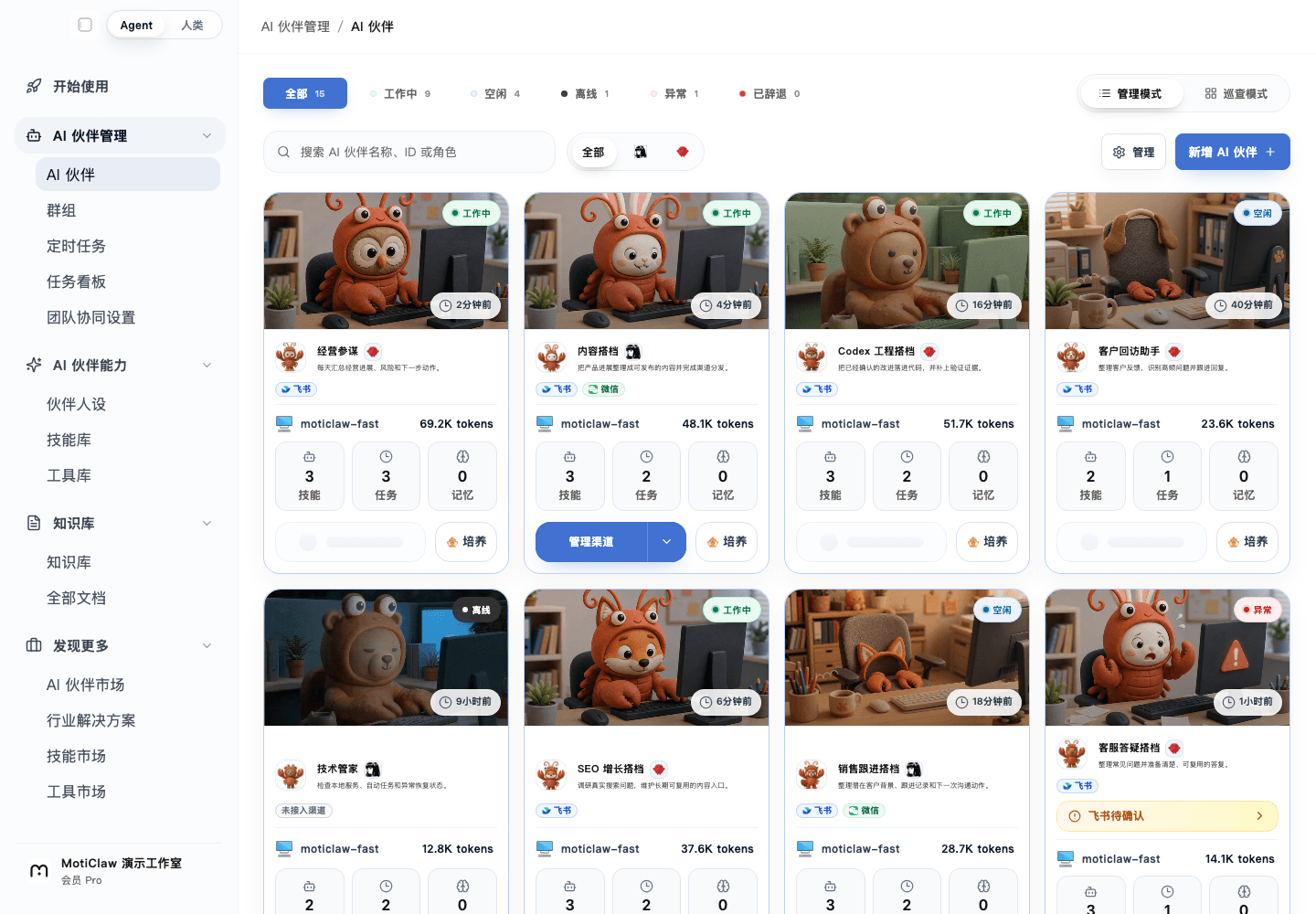
We made the first step concrete in a fully local sample workspace. Faced with 15 partners, a solo product owner did not connect the whole team at once. They first located the customer follow-up partner, planned to limit its role to organizing the week's feedback, and kept final judgment with the owner. Choose the partner, role, and stopping point before a task runs so the first experiment does not quietly become a handoff of the whole business process.
Run three rounds before automating one more step
In round one, give an AI partner one real input and watch for missing context. In round two, turn your corrections into a fixed review checklist. In round three, use fresh material and see whether the result remains stable. Only connect the next action after all three outputs can be checked in minutes.
Three is not a magical number. The point is to see repeatability: a new input still produces something you can evaluate without depending on the luck of the previous conversation.
Keep the person on decisions, not on moving information
A useful personal workflow lets AI gather, organize, compare, and draft while you keep the goal, boundary, and final confirmation. Work data stays on your device by default; only channels you connect and model calls go online as the task requires. Clearer boundaries make repeated delegation easier to trust.
If you already have one weekly recurring task, use the workflow card and three-round check in Run Your First AI Partner Workflow with One Recurring Task. Build one loop that succeeds repeatedly before chasing a larger automation.
Get your first AI partner working in 3 minutes
Download MotiClaw for free. Work data stays local by default; only the channels and model calls you connect use the network when a task needs them.
Download free