
01
Scope can be repeated
The client and practitioner can both explain what version one handles, which inputs it needs, and where people decide.
Workflow
A successful client demo proves one run worked. A maintainable delivery also needs fixed inputs, acceptance criteria, human checkpoints, and a recovery path. Put them on one checklist so the next deployment does not depend on the delivery practitioner's memory.
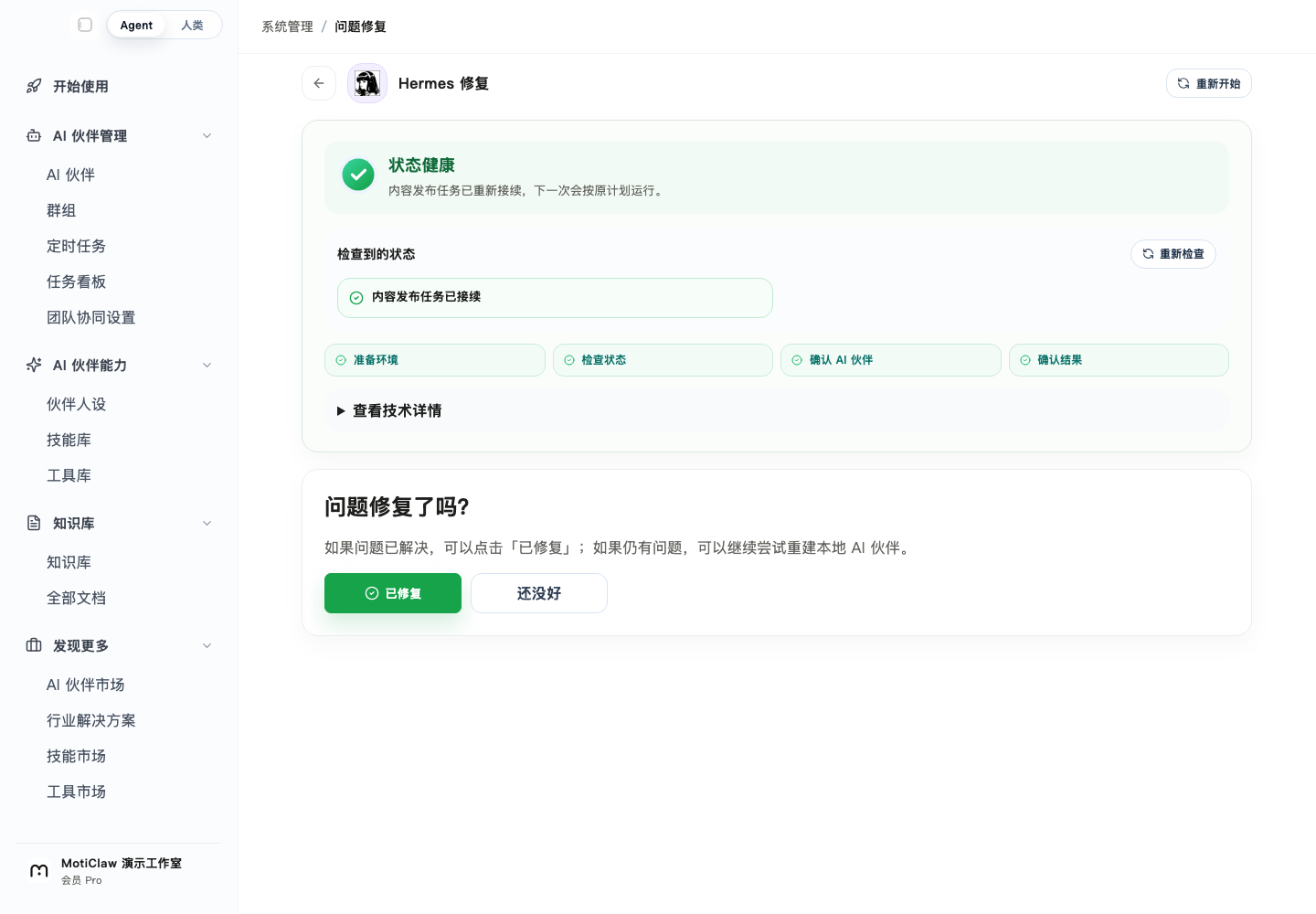
See how the real workbench carries status, tasks, and human review before deciding whether the approach fits.
Open interactive preview01
The client and practitioner can both explain what version one handles, which inputs it needs, and where people decide.
02
Every step has an observable completion signal, so delivery goes beyond a single successful run.
03
When material, access, or runtime fails, the team knows where to stop, who decides, and how to restart.

Start here
Put inputs, execution, and human review into one clear path before expanding it.
Describe the repeated work as concrete actions, then list the cases version one leaves out and the decisions that remain human-led.
Confirm sources, required fields, freshness, runtime device, service access, and the maintenance owner. Stop when a required fact is missing.
State what the practitioner and client must see, such as recovered status, saved output, an empty error check, or an explicit human checkpoint.
Add missing fields, stale sources, access failures, and timeouts. The workflow should preserve context, explain the cause, and expose a repeatable recovery entry.
Record who reviews runtime state, who handles exceptions, where configuration changes live, and which signal returns the work to the FDE.

Deploying an AI assistant is still too broad for acceptance. Continue until the checklist names the client material, the output the AI partner prepares, the point where the client reviews it, and the signal that closes one run.
A narrow first version is easier to finish. Start with weekly client-feedback preparation and a review queue, for example, without also promising automatic replies, publishing, and changes inside the client system.
A future maintainer should understand the current scope, runtime conditions, and recovery path from this checklist alone.
MotiClaw brings AI partners, tasks, configuration, and operating state into a local-first workbench. The recovery view in the screenshot shows checks, recovery steps, and the final state so the practitioner can continue, inspect again, or return the decision to a person.
The workbench organizes repeated actions and preserves observable state. The FDE and client still define the goal, acceptance criteria, data boundary, and final commitment. Clear responsibility matters more as automation expands.
Track preparation, human takeover, recovery, and client review across one complete cycle. Add another source or workflow only when normal inputs repeat, exceptions stop with an understandable reason, and review takes less effort.
If the original practitioner still has to supply missing context, guess runtime state, or rescue most runs, improve the checklist and recovery rules first. More agents would only widen the area that needs diagnosis.
FAQ
Start with the repeated client work, version-one scope, input source, and accepted result. Add deployment, access, and maintenance details once those four can be repeated clearly.
Test missing material, stale input, access failure, and timeout first. A delivery version should explain failure, preserve context, and return people to a clear recovery point.
Keep explicit approval for client commitments, public publishing, pricing and payments, account access, sensitive-data sharing, and recovery choices after an exception.
Reuse it when normal inputs produce repeatable acceptance, exceptions stop safely, maintenance ownership is handed over, and manual rescue by the original practitioner keeps falling.
Next
MotiClaw fits FDEs and AI delivery builders who need one local-first platform for consulting, deployment, configuration, and long-term client handoff.
For FDEs and AI delivery builders, this guide explains how to turn client needs, deployment prep, agent configuration, data boundaries, and maintenance into a repeatable local AI delivery path.
For FDEs and AI delivery builders, this guide turns post-delivery configuration notes, health checks, maintenance ownership, data boundaries, and expansion planning into a clear client handoff.
See how MotiClaw brings agent onboarding, status, daily operations, configuration, and delivery into one local-first workbench for FDEs, AI indie developers, and founders.
Download MotiClaw for macOS or Windows. Install in minutes, start managing your local AI partner team, and keep your data on your own device.
Run the first step