
Do Not Judge an AI Partner by One Good Answer
Review completion rate, queue and run time, failure types, and usage each week. Judge reliability against your own operating tolerance while keeping only the metadata you need.

One polished answer proves that one result was usable. Once a solo operator relies on an AI partner for customer follow-up, content preparation, or release checks, reliability has to cover repeated work. How many assigned tasks finished, how many passed review, how long work waited and ran, and whether a failure left enough evidence for recovery all matter.
The observation window is easy to miss. Watching only the latest response hides a queue that grows longer each day, failures that cluster around one input type, or usage that rises without producing more accepted work. A weekly view makes those patterns visible.
Define reliability in terms your business can tolerate
Google's SRE guidance describes an SLI as a quantitative measure of one aspect of service and an SLO as a target value or range for that measure. It also starts from behavior users actually care about. A personal workflow does not need the full operating system of a large service team. The useful order is to define a usable business result first, then choose the measurements that expose drift.
A customer follow-up partner might be acceptable when every scheduled conversation enters the review list, uncertain items stop for clarification, and no reply is sent without approval. There is no universal percentage for this. One missed customer message may need same-day action, while an internal research task might tolerate half a day of delay. Set the target beside the consequence.
Keep four groups of signals in the weekly review
- Task completion rate. Count only the recurring tasks expected in the period, and count a completion only after it passes review. An output that still lacks a required fact remains unfinished.
- Queue and run time. A growing wait can expose a backlog or a partner that is not starting promptly. A sudden increase in run time can point to larger inputs, a stalled tool, or repeated attempts.
- Failure type. Preserve the original category and the last usable state. Temporary errors, missing inputs, human decisions, and unrecoverable failures lead to different next actions even when the total count is identical.
- Usage beside accepted output. Usage becomes useful when viewed with completed tasks and rework. Rising consumption with flat accepted output is the signal to investigate.
GitHub's official Actions metrics use average run time, queue time, and failure rate to observe workflow performance, while usage metrics help identify expensive workflows and jobs. Those measures come from software delivery and cannot set the standard for customer or content work. They still offer a practical set of things to watch.
Start with exceptions before collecting more data
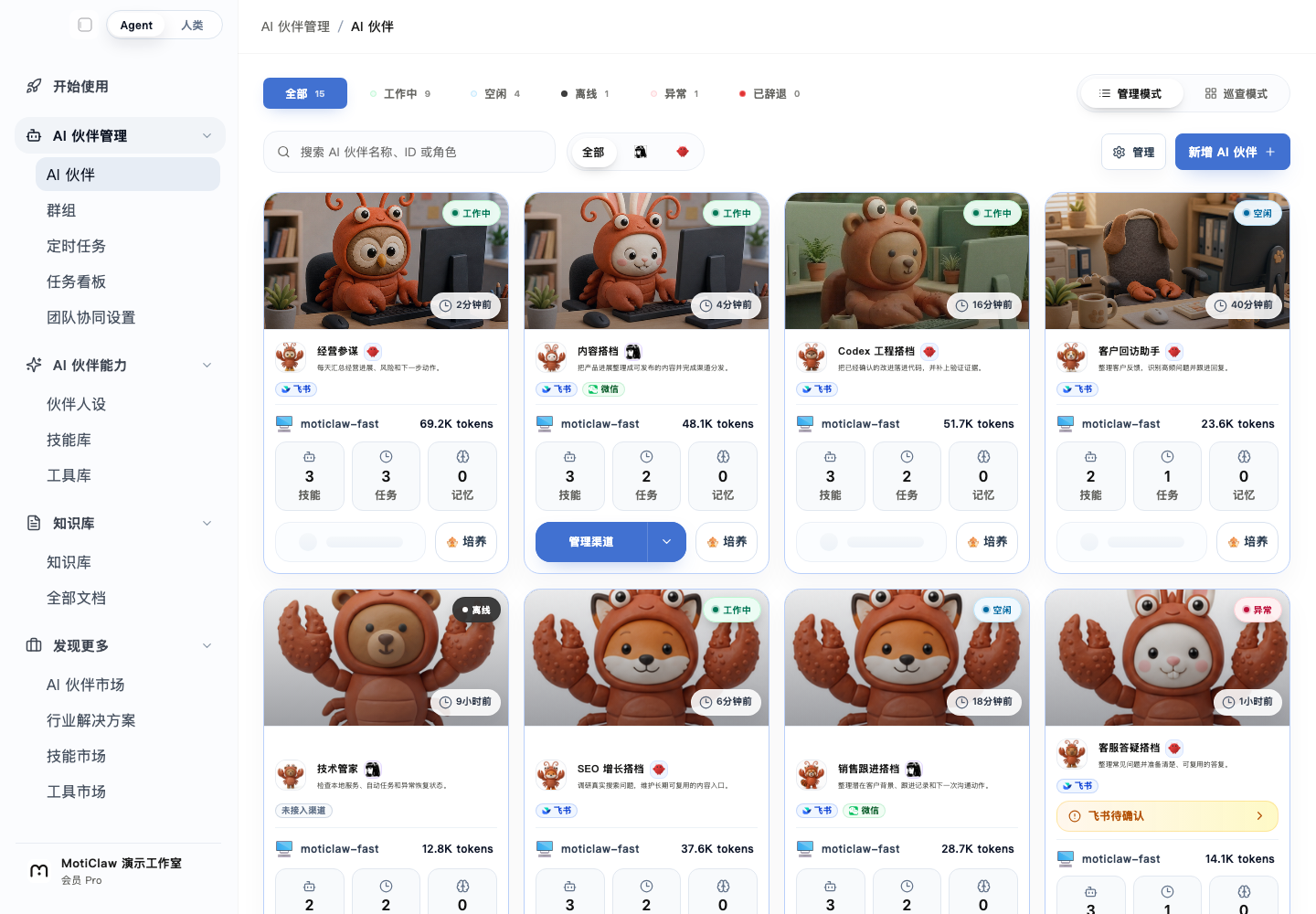
This MotiClaw sample workspace puts working, idle, offline, and failed states for 15 partners in one view. Each card also exposes task count and usage. A solo operator can begin a weekly review with the offline and failed partners, inspect recent activity and tasks, then decide whether to pause, supply missing input, or return the work to a person.
MotiClaw supplies raw signals such as status, tasks, recent activity, health, and usage in this case. The completion rate and target ranges in this article remain your operating definitions. The product is not being described as an automatic SLO calculator. A clear overview still cannot decide which outcome your business should accept.
Stop recording when you can diagnose the work
OpenTelemetry defines observability semantics for generative AI agents, workflows, and tool execution, including an error type when an operation fails. Its attribute guidance also warns that tool arguments and results may contain sensitive information. For a personal workflow, a minimal record can be limited to a task identifier, start and end time, final state, failure type, usage, and whether a person intervened.
Do not retain customer text, full prompts, tool arguments, or model output when diagnosis does not require them. Work data stays on your device by default; only channels you connect and model calls go online as the task requires. Spend ten minutes on these four signal groups each week, then adjust the targets after two or three weeks. That gives you a baseline grounded in your own work before you automate another step.
Get your first AI partner working in 3 minutes
Download MotiClaw for free. Work data stays local by default; only the channels and model calls you connect use the network when a task needs them.
Download free